
Why are we using Facebook Groups instead of Marketplace?

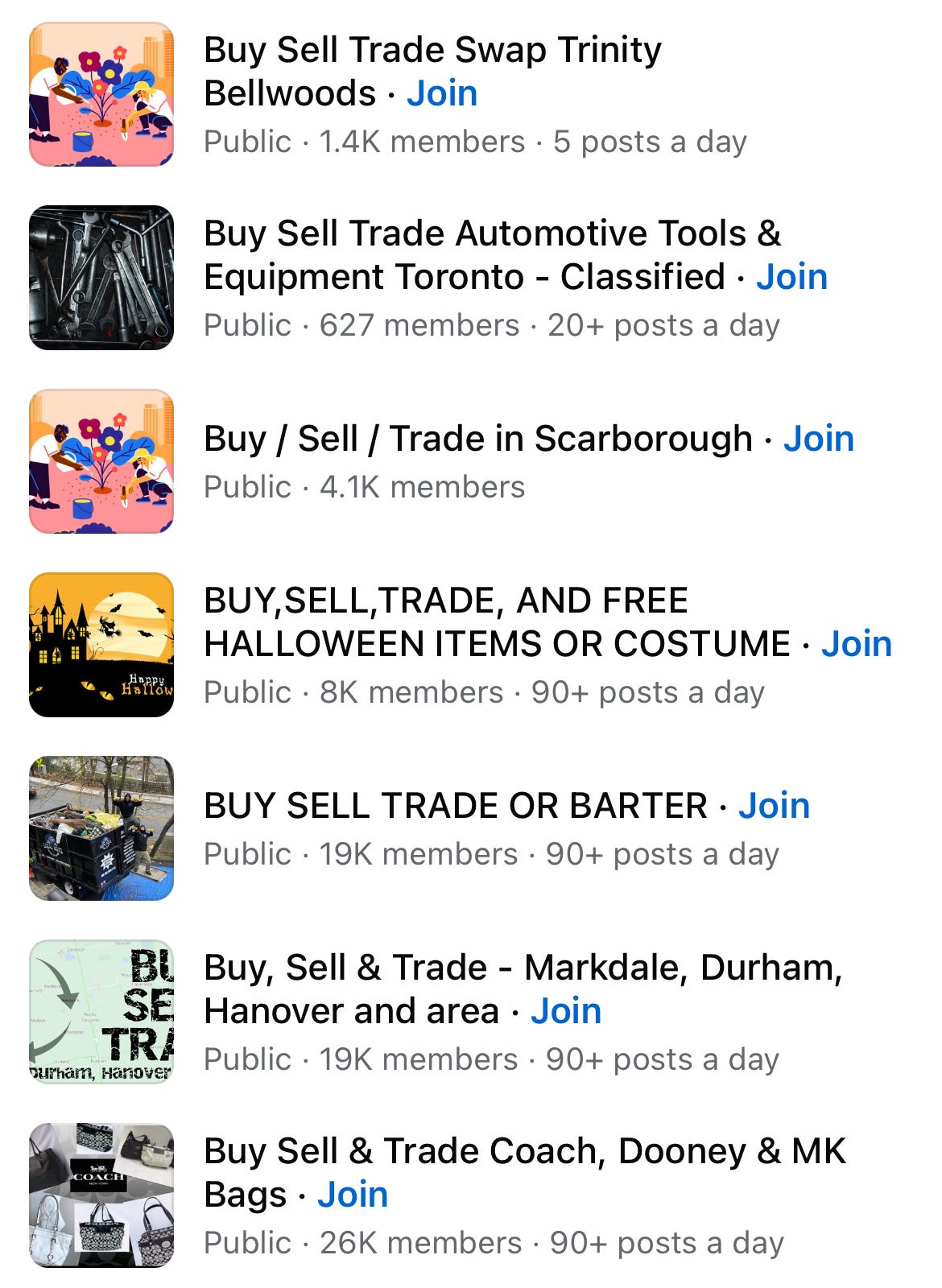
Recently, I started using Facebook Marketplace more often and along the way, I discovered many active and large buy-and-sell Facebook Groups. This made me wonder: Why are people still relying on Groups when Marketplace is designed to serve the same purpose?
In this post, I break down the differences between Marketplace and Groups, outline the key user needs behind each, and suggest ways Marketplace could better serve those needs.
💡 This analysis focuses on Marketplace in Canada, which lacks US-only features such as Meta Pay and integrated shipping.
Context & Problem
Facebook Marketplace is designed for peer-to-peer buying and selling, yet many Facebook Groups for buy-and-sell still exist with frequent activities. Why are users choosing Groups when Marketplace in theory serves the same purpose? And what opportunities does this reveal to improve Marketplace?
Most people on Marketplace are individuals rather than businesses. There are two primary personas:
Sellers use Marketplace to:
list items easily and for free
declutter and resell secondhand goods
earn incremental income instead of throwing out or donating items
Buyers use Marketplace to:
find items cheaper than retail
inspect items in person before buying (if sellers allow)
access a greater variety of items than local thrift stores
Groups offer more options to choose from
Groups are not tied to location in the same way Marketplace is. Although some Groups are location-specific (e.g., Toronto used cars buy & sell group), others can include users from anywhere in the world. Marketplace, on the other hand, defaults to the user’s current location and has a narrower search radius. This results in Groups having higher item inventory, and buyers have a higher chance of finding items in a Group.
Recommendation: Encourage more listings
Marketplace doesn’t have direct control over how many items are available, so it can only get more sellers or encourage existing sellers to list more items.
One way is to proactively prompt users to post based on their interactions. For example, for users who recently joined multiple rental Groups, Marketplace can prompt if they would like to sell furniture. For users who are frequent buyers, Marketplace can prompt if they would like to start selling on the platform as well.
Another way is to make the selling or listing process easier. Marketplace can leverage Meta’s advanced AI technology to streamline the experience. For example, multi-modal AI models can be used to generate item descriptions based on the product photos or videos, and Machine Learning models can be used to recommend the best price to set based on local transaction histories of similar items.
Success metrics:
Number of active sellers (sellers with at least 1 listing)
Average number of listings per seller
Groups make it easier to find niche items
Groups are often created around specific brands or categories (e.g., Pokémon cards, Designer bags). Marketplace prioritizes breadth of items and is purely dependent on the local sellers. The only way for buyers to find specific items is through the search functionality. However, the current search algorithm remains unsatisfactory. It is over-personalized and includes unrelated search results, usually based on the user’s search history.
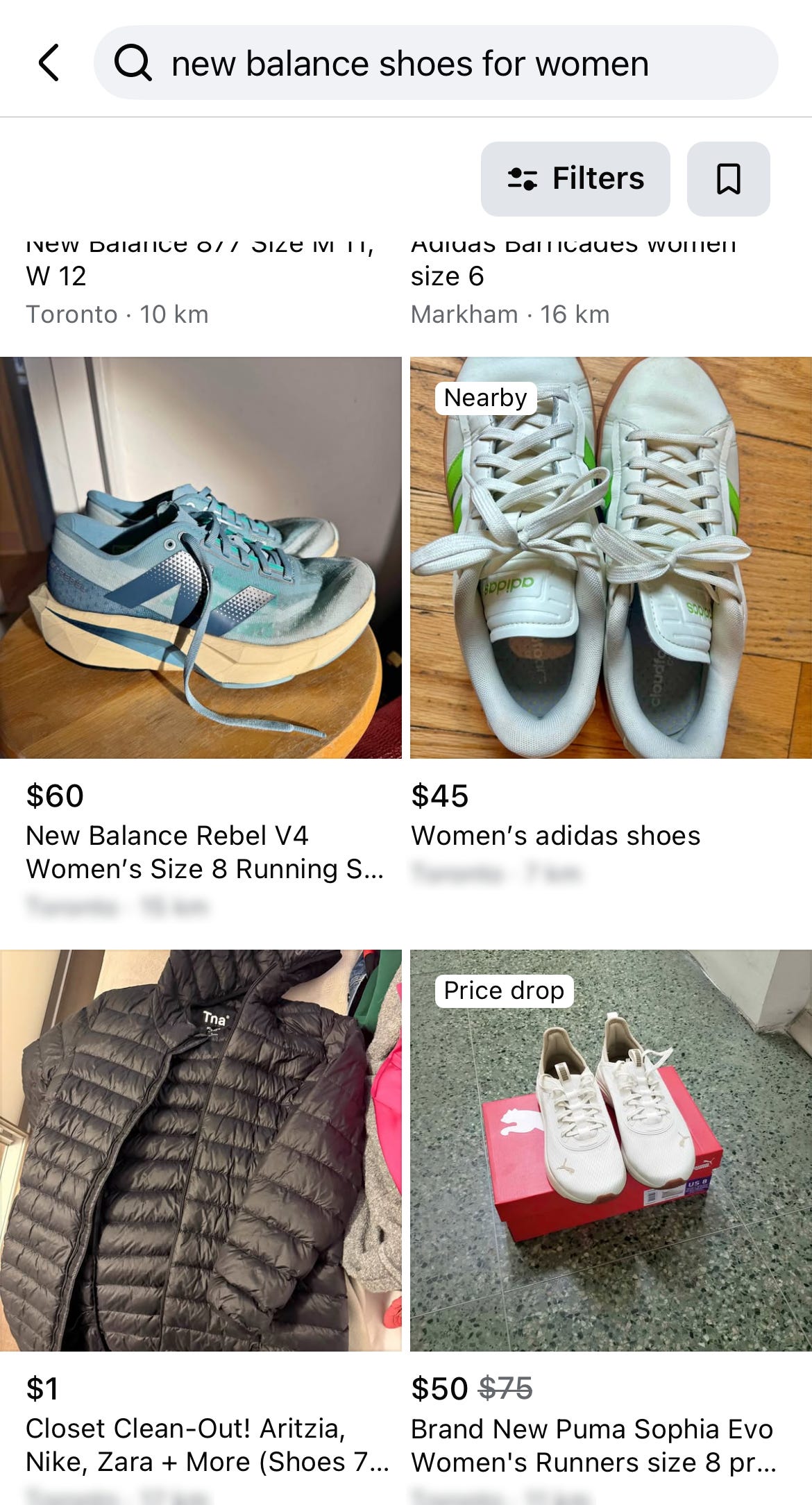
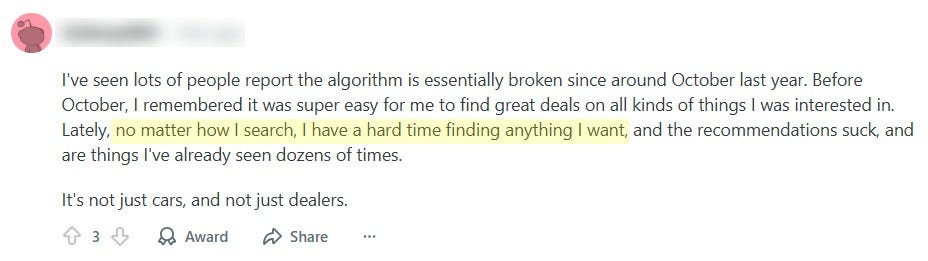
Recommendation: Improve search algorithm relevance
Marketplace can adjusts its algorithm to return only the relevant products, allowing buyers to search for items more easily. The personalization and recommendation of other items works well for the home feed, where user can explore more products, but when implemented in the search algorithm, it adds noise to the search result.
Success metrics:
Clickthrough rates in search results
Conversation rate from search to buyer & seller conversation
User satisfaction reported on Marketplace or online
Groups are safer
There are two main areas of safety: user and product/listing.
For user safety, some Groups require admin approval or have screening questions before users can join them, filtering out bots or spam accounts. For product safety, Group admins can remove irrelevant or harmful posts.
For Marketplace, although it has a profile rating system and a listing screening check, its effectiveness remains to be questioned. For example, I often come across ghost or spam sellers who never respond or are purely posting to promote their business, or misleading item listing that are marked as “free” or “$1” just to gain traction.
Recommendation: Implement stricter safety filter and incentivize quality
For user safety, Facebook can implement a stricter profile requirement. For example, in order to participate in Marketplace, users have to include a profile picture showing their face. Marketplace can also introduce optional verification to cross check user’s ID and profile picture, and those who pass verification can receive a verified badge.
For product safety, Marketplace can reward higher quality listings (e.g., listings with videos or detailed descriptions) with more visibility. In addition, Marketplace can implement stricter product listing filtering, leveraging image recognition to identify if listing pictures are used on other websites, or if the images are potentially AI-generated.
Success metrics:
Number of reported spam profiles and listings
Number of ghosting in conversations
Successful transaction rates per buyer/seller
Abandon rate from Marketplace profile creation & listing creation process (potentially due to stricter safety requirements)
Additional Thoughts
The goal is not to eliminate Groups and push all users to Marketplace. Groups emerged from real community needs, and Facebook intentionally supports the coexistence. For example, there is a dedicated Groups tab within Marketplace, and sellers who post on Marketplace can easily cross-post to other Groups.
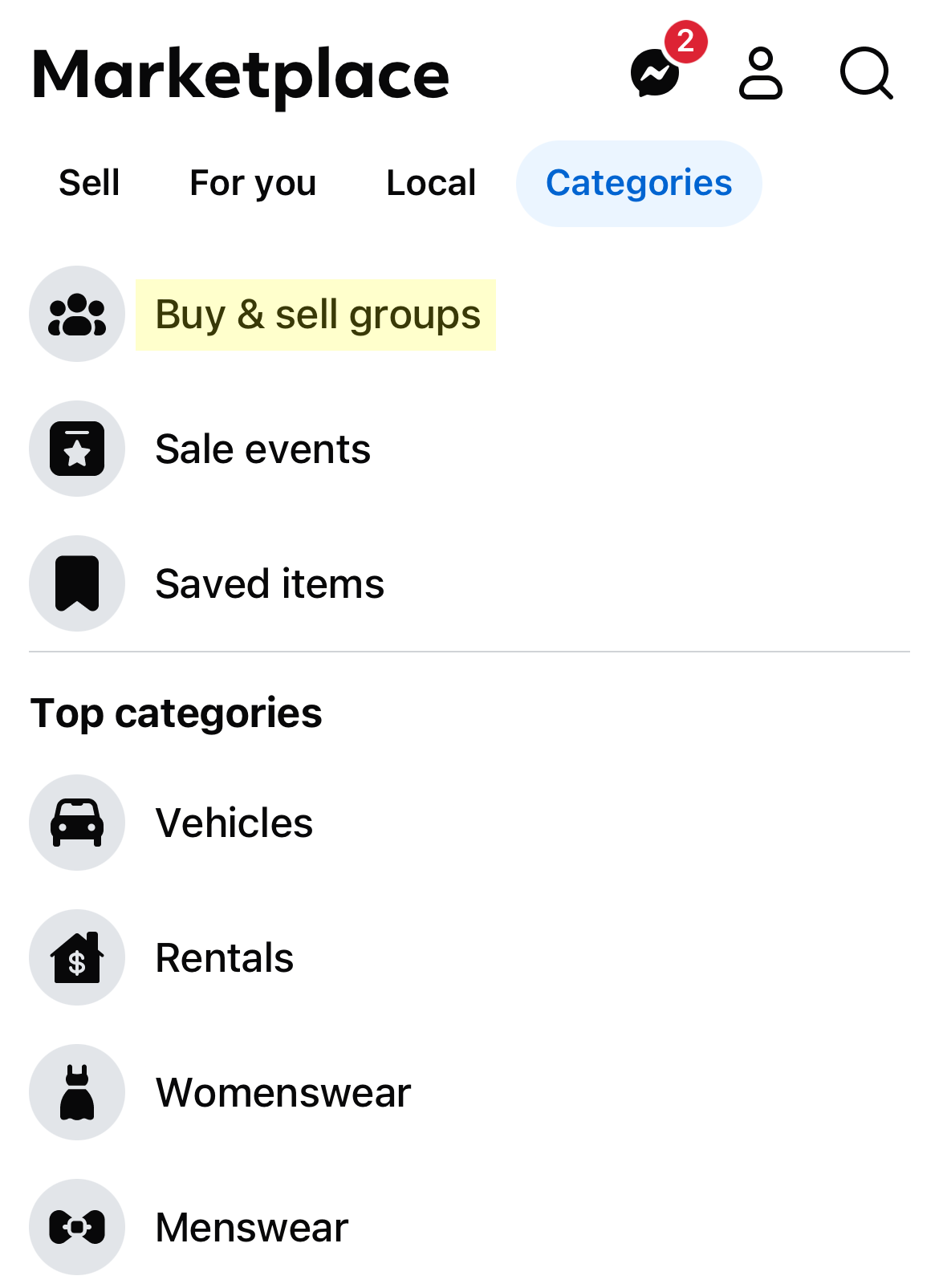
However, Marketplace still has meaningful gaps: inventory availability, targeted search, and safety perception. By strengthening these areas, Marketplace can become a better platform to facilitate local buy-and-sell.
Like what you read? Let’s connect!
🌐 LinkedIn: linkedin.com/in/lia-weng
👩🏻💻 Github: https://github.com/lia-weng
📩 Email: lia.xin.weng@gmail.com